Buying a home in Japan you won't live in? What a tax agent (nozei kanrinin) does
If you buy a holiday home or an investment property in Japan but live abroad, Japanese tax notices will keep coming - in Japanese, to an address in Japan. A tax agent (nozei kanrinin) is the local contact who receives them and pays the taxes on your behalf. This Q&A covers which taxes you will face as a non-resident owner, when you need a tax agent, what a tax agent can and cannot do, and who can act as one.
Buying a holiday home in Niseko, a pied-a-terre in Tokyo or a flat by the sea in Kanagawa is now a common plan for people who live outside Japan. What often comes as a surprise is what happens after the purchase: Japanese tax notices keep arriving every year, in Japanese, at an address in Japan, with deadlines.
The person who handles this on your behalf is called a tax agent (nozei kanrinin). This article explains which taxes you will face as an owner who does not live in Japan, why you generally need a tax agent, and what a tax agent can and cannot do.
What taxes will I pay on a home in Japan if I don’t live here?
A one-off acquisition tax after you buy, fixed asset tax every year, and income tax if you rent the property out.
| Tax | When | Assessed by |
|---|---|---|
| Real estate acquisition tax | Once, a few months after you buy | The prefecture |
| Fixed asset tax and city planning tax | Every year, charged to the owner as of January 1 | The city or ward (the Tokyo Metropolitan Tax Office in the 23 wards) |
| Income tax | Every year you have rental income | The tax office |
Both the acquisition tax and the fixed asset tax are based on the government’s assessed value of the property, not the price you paid, and reductions apply to some homes. Fixed asset tax bills usually arrive between April and June and are paid in up to four installments or in one go; the timing depends on the city.
Taxes paid at closing, such as the registration and license tax, are usually handled through the judicial scrivener (shiho shoshi) at settlement, so you do not need a tax agent for those.
Do I need a tax agent (nozei kanrinin)?
In most cases, yes. Japanese law generally expects owners with no address or residence in Japan to appoint a tax agent and notify the authorities.
The rule for national taxes such as income tax is in Article 117 of the Act on General Rules for National Taxes, and local taxes such as fixed asset tax follow the Local Tax Act. In practice, a tax agent gives the tax office and the city a contact in Japan who can receive notices and pay on time.
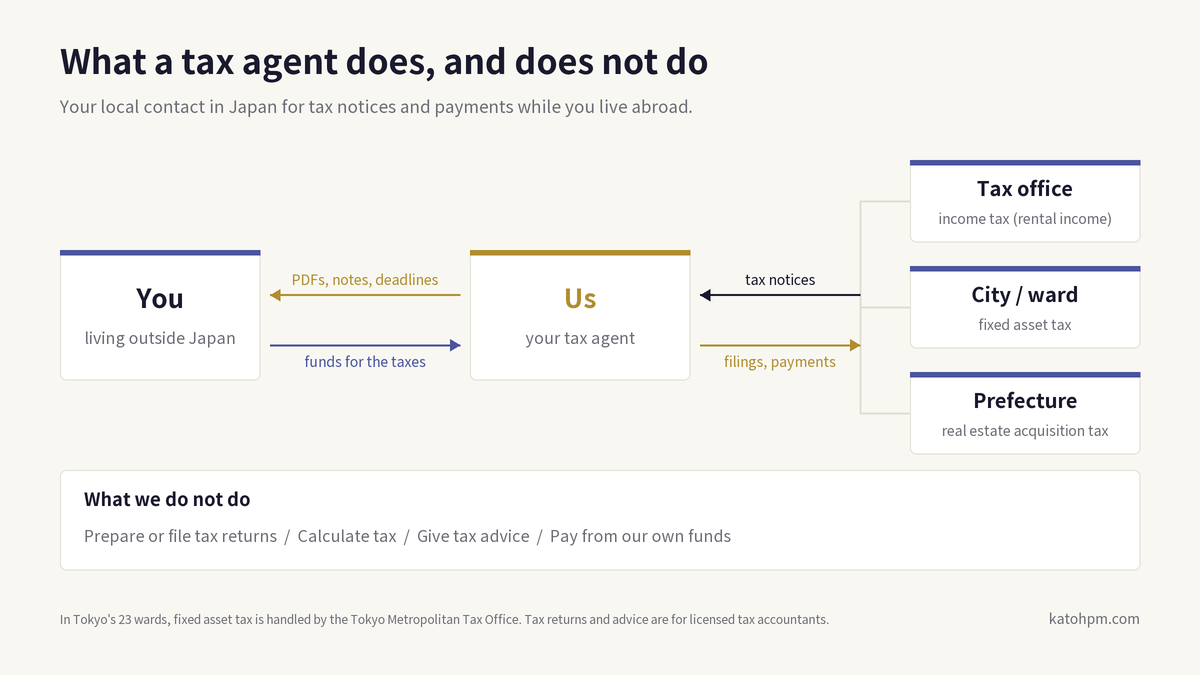
Without one, notices may be mailed to an overseas address late or not at all, and late payment adds charges. Each office is notified separately:
| Tax | Who to notify |
|---|---|
| Income tax | The tax office for your place of tax payment |
| Fixed asset tax and city planning tax | The city or ward where the property is (the Tokyo Metropolitan Tax Office in the 23 wards) |
| Real estate acquisition tax | The prefecture where the property is |
The forms and exact requirements differ between offices, so they are worth confirming for your property.
What if I rent the property out?
Rental income from Japanese property is taxed in Japan, and you file a Japanese tax return every year.
If the tenant is a company (for example, renting the home for an employee), it withholds 20.42% of the rent and pays it to the tax office. If the tenant is an individual renting the home to live in, there is no withholding. Tax withheld is settled when you file your return, and you may get some back once expenses are deducted.
Short-term rentals (minpaku) have their own rules: the property generally has to be registered under the Private Lodging Business Act, and when the owner does not live there, management must be entrusted to a registered management business. Local rules can be stricter. We do not manage short-term rentals.
Are there any other filings after I buy?
Possibly a report under the Foreign Exchange and Foreign Trade Act. A non-resident who acquires real estate in Japan is generally required to report it to the Minister of Finance through the Bank of Japan within 20 days.
There are exemptions, including property acquired for the residential use of yourself or your relatives. Whether a holiday home you use only part of the year falls under the exemption is something to confirm before you buy.
What does a tax agent do, and what can’t they do?
A tax agent receives notices, keeps you informed and pays the taxes. Preparing tax returns and giving tax advice are reserved for licensed tax accountants (zeirishi).
In some countries, “tax agent” means a licensed tax professional. A nozei kanrinin is different: no licence is needed, and a friend, a relative or a company in Japan can act as one. That also means a nozei kanrinin who is not a licensed tax accountant cannot prepare your return or advise you on your taxes.
| A tax agent can | A tax agent cannot (unless a licensed tax accountant) |
|---|---|
| Receive tax notices on your behalf | Prepare or file your tax return |
| Tell you what arrived and when it is due | Calculate your tax |
| Pay taxes from funds you provide | Advise you on how to reduce your tax |
You remain the taxpayer throughout. The tax agent does not become liable for your taxes.
Who should I ask to be my tax agent?
Anyone in Japan you can rely on for years: a friend, a relative or a company.
A friend in Japan may be happy to help for a while, but property taxes come every year for as long as you own the home, and friends move or get busy. If you have no one in Japan you can ask, or would rather not rely on a favour for years, a company is the practical choice.
What does our tax agent service include?
For US$200 a year, we file the appointment, receive your notices, send them on with English notes, remind you of deadlines and pay the taxes from funds you send us. Properties anywhere in Japan.
- Filing the appointment: we prepare the forms, you sign them, and we file them with the tax office, the city or ward and the prefecture
- Notices: we send each notice as a PDF, normally within 3 business days of receiving it, with a short note in English on what it is, the amount and the due date
- Reminders: we contact you before payment deadlines
- Payments: you send the amount due in advance, and we pay it before the deadline
- Ending: when you no longer need us, for example after selling the property, we file the termination
The fee is paid one year in advance by Wise (US dollars) or USDC. How payments from abroad work is explained in How to pay a real estate agent in Japan from abroad.
We do not prepare or file tax returns, calculate tax, give tax advice or pay taxes from our own funds. If you rent the property out, please file yourself or hire a licensed tax accountant.
If you are still looking for a home, we also broker purchases in Tokyo, Kanagawa, Chiba and Saitama, in English or Japanese, as a separate engagement. See Buying.
Details of the service are on our tax agent page. To get in touch, use the form or LINE and tell us where you live and where the property is (or will be).
Note: This article summarises general rules and our own practice as of November 2026. Whether a filing is needed, the forms used and the amount of tax depend on your circumstances and on the office concerned; please confirm with the tax office, the local government or a licensed tax accountant. This English article is written for owners who live outside Japan and is not a translation of the Japanese version, which is written for Japanese owners moving abroad.